


Compliance
Supports compliance with CMS MDS 3.0 requirements, and federal and local pain management guidelines.
Staff empowerment
Equips healthcare teams with objective insights to guide informed, personalized care.
Seamless integration
Point-of-care, time-stamped assessments flow directly into eMAR and EHR platforms in real time.
“As an organization that is committed to, and focused on, the care of older adults, PainChek will play a meaningful role in enhancing the work that we do. It will have a positive impact on quality of life for our elders while helping our staff to better understand and effectively treat the residents.”
– Carol Silver-Elliott, President and CEO, Jewish Home Family
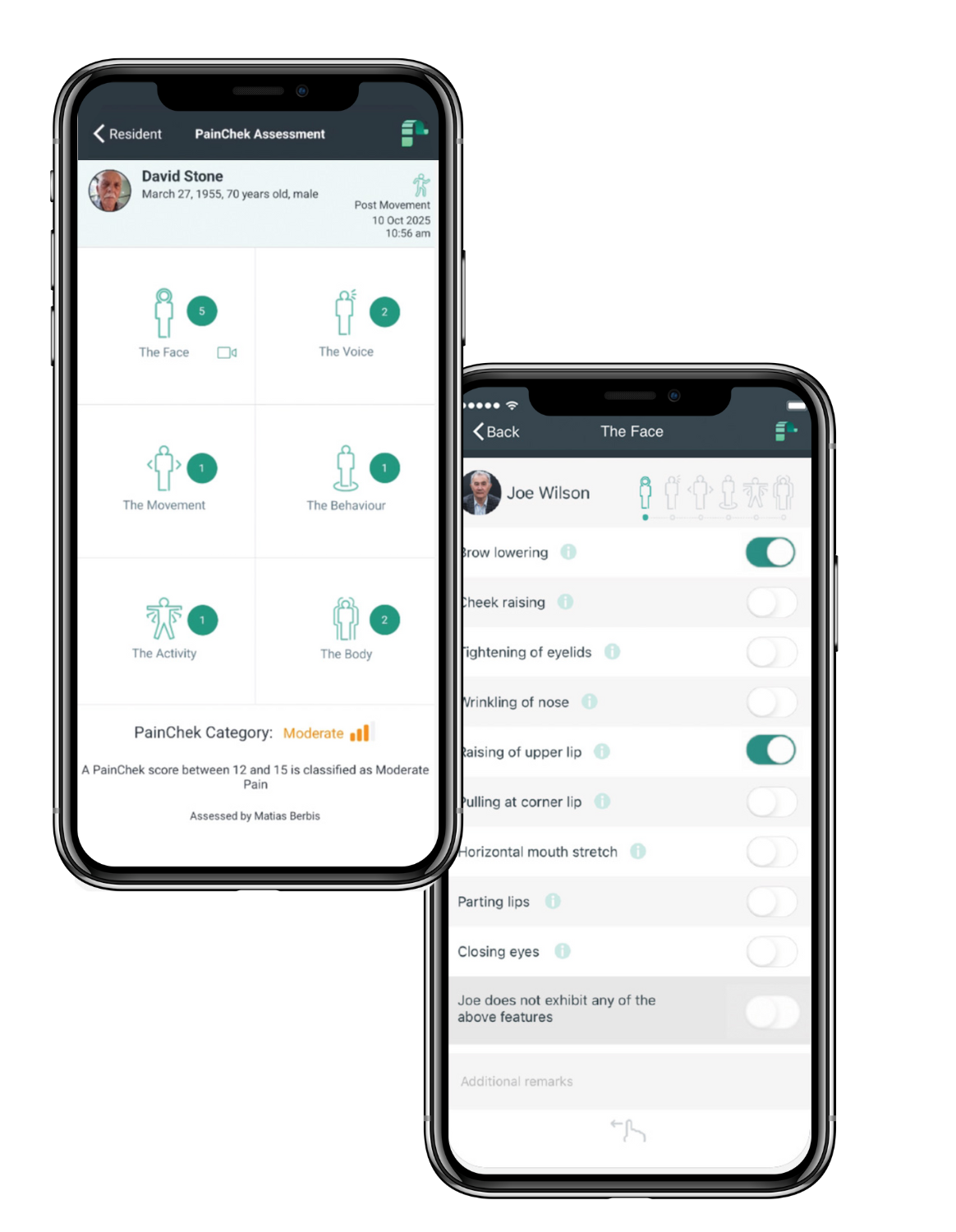
How PainChek® works
Available on smartphones and tablets, PainChek® uses evidence-based AI technology to automatically detect facial micro-expressions that indicate pain, along with digital checklists to record carer observations of other pain-related features.
All assessment data (but no facial images) is securely stored in PainChek®’s cloud portal, enabling continuous tracking of pain trends and treatment effectiveness.
PainChek® qualifies as an RTM-eligible medical deviceFor the first time, US healthcare providers can now claim reimbursement for pain monitoring through CMS, using PainChek®. This creates a new pathway to monitor and manage musculoskeletal pain in people with moderate to severe dementia who cannot reliably self-report their pain.
Scottish Government-funded pilot: Key outcomes


REDUCTIONS:
25% reduction in analgesic use
40% reduction in falls
33% reduction in antipsychotic use
27% reduction in the use of anxiolytics and hypnotics
27% reduction in dependency scores
21% reduction in antidepressant use

INCREASE IN BMI SCORES

HIGH WORKFORCE APPROVAL
With a large majority of staff reporting PainChek® as an effective digital pain management solution

ESTIMATED ~£66 MILLION COST SAVINGS
For the Scottish aged care system over five years
Scottish Government-funded pilot: Key outcomes

25% reduction in analgesic use
40% reduction in falls
33% reduction in antipsychotic use
47% increase in BMI scores
27% reduction in the use of anxiolytics and hypnotics
27% reduction in dependency scores
21% reduction in antidepressant use

High workforce approval, with a large majority of staff reporting PainChek® as an effective digital pain management solution

Estimated ~£66 million cost savings for the Scottish aged care system over five years